
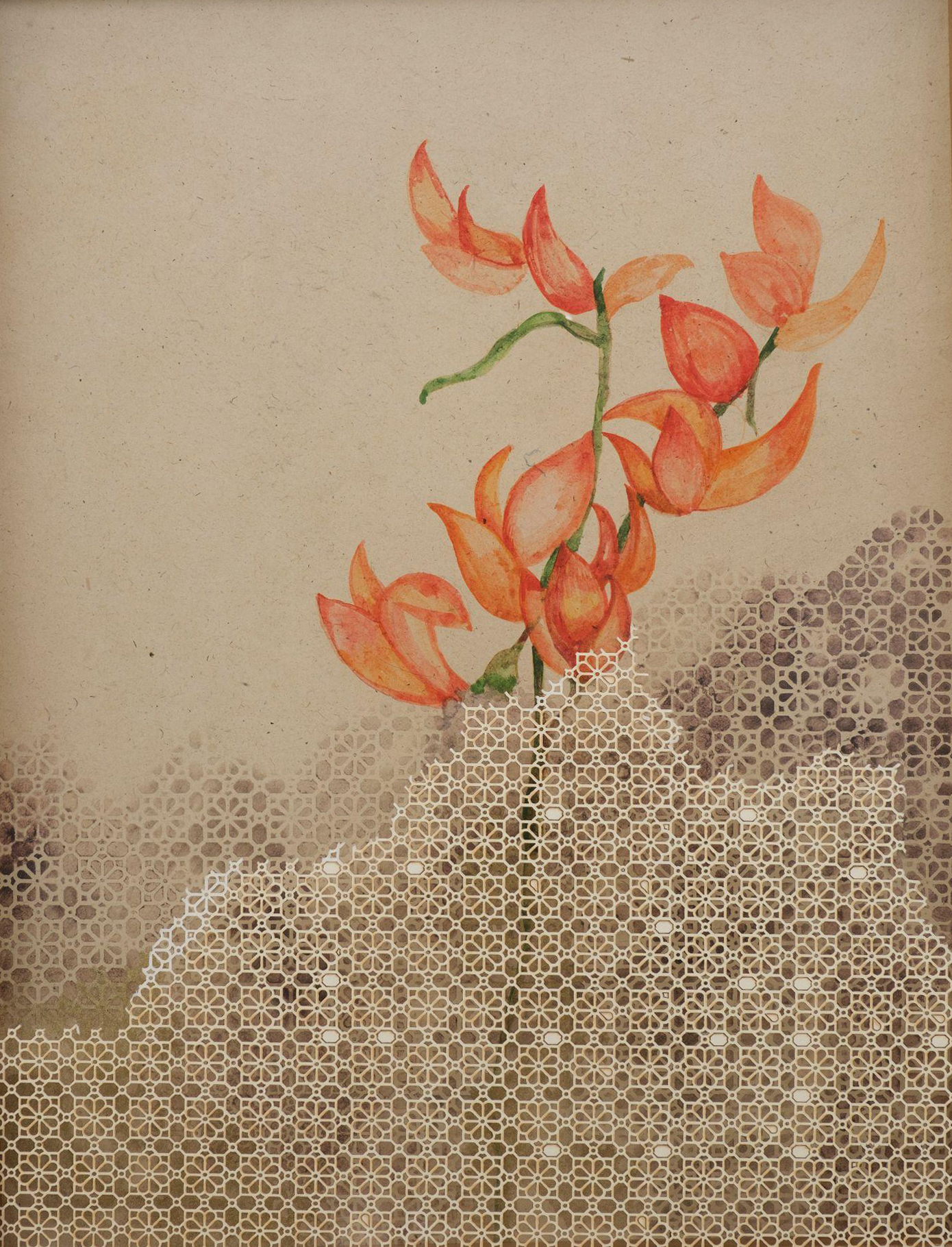
What the Light Remembers
By Nvyā Editorial | Published on Sep 11, 2026 | in Art Curators, Art gallery, Nvya Young Talents
Gallerie Nvya presents What the Light Remembers, a monographic exhibition of recent works by artist Riddhi Shah, with a preview on Friday, 25th September 2026, from 6 to 8 PM. The exhibition will be open to the public from 26th September to 15th November 2026 at the gallery’s Saket space.
Working in gouache, watercolour, gold pigment, and walnut stain on Sanganeri and acid-free paper, Shah brings together two seemingly distinct vocabularies in this body of work—the geometric precision of the jaali and the generative structures of the natural world—to explore memory not as a fixed record of the past, but as something fugitive, selective, and continually reconstructed.
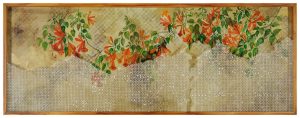
Riddhi Shah, Blooming Veil, 23.5 x 64 inches, Gouache, gold pigment and walnut stain on Sanganeri paper & acid free paper cut jali, 2026
The jaali, long used across the architecture of the Indian subcontinent as window, screen and spatial divider, becomes in Shah’s hands both a formal device and a way of thinking. In works such as Champa Outside My Window, Nilgiri and Krishna Kamal, paper-cut jaali patterns are set in conversation with painted botanical imagery. Shah cuts away sections of the paper itself, introducing literal absence into the composition so that negative space becomes as material as the painted surface. The resulting works shift with light, shadow and the viewer’s position — echoing the way memory reveals as much as it withholds.
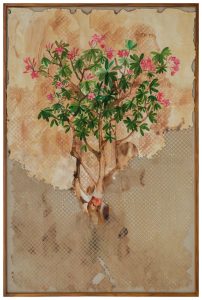
Riddhi Shah, The Garden Remembers, 72 x 48 inches, Gouache, gold pigment and walnut stain on acid free paper & paper cut jali, 2026
Shah’s process begins on Sanganeri wasli, a layered paper historically tied to Indian painting traditions. Gouache lends precision and opacity; watercolour allows translucency and diffusion; walnut stain, behaving with partial unpredictability, leaves blooms and gradations across the surface reminiscent of age and weathering. Gold pigment recalls the illuminated margins of Mughal miniature painting, in which botanical ornament frequently expanded beyond the border to become part of the image itself — a historical relationship Shah reworks throughout the exhibition.
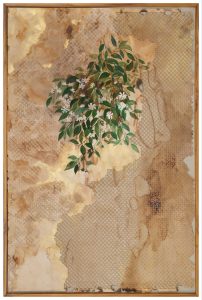
Riddhi Shah, Between Bloom and Falling-Parijat, 72 x 48 inches, Gouache, gold pigment and walnut stain on acid free paper & paper cut jali, 2026
Running through the show is a broader inquiry into pattern and freedom: whether the recurring structures found in nature — phyllotaxis, radial symmetry, branching systems — parallel the inherited structures, habits and histories that shape human life, and whether freedom lies not in the absence of structure, but in the openings a structure makes possible.
– Priya Pall

