
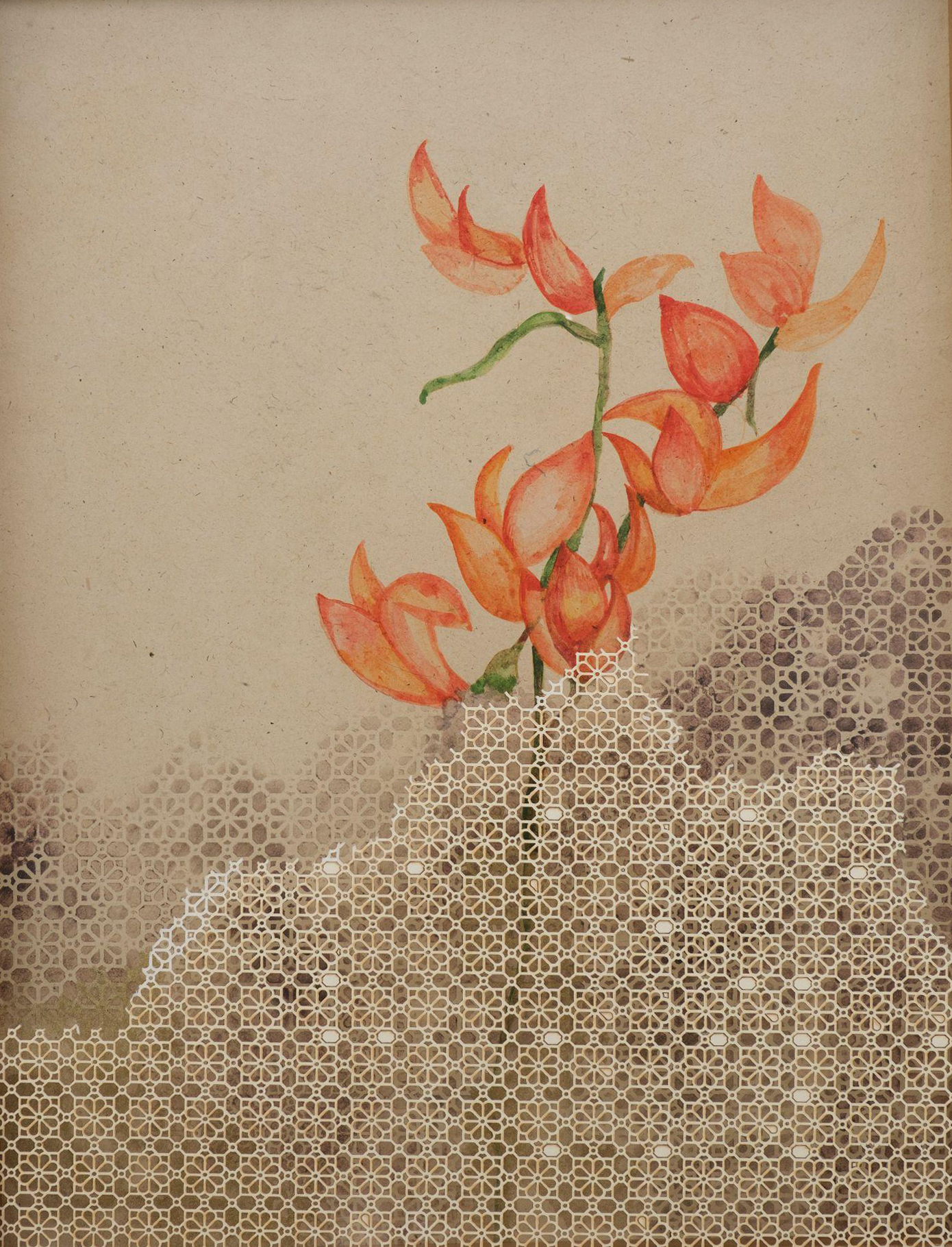
What the Light Remembers
By Nvyā Editorial | Published on Sep 11, 2026 | in Art Curators, Art gallery, Nvya Young Talents
My first encounter with Riddhi Shah’s practice was through Relocating (2011), a sequence of six paintings on embossed paper. Seen now, against the trajectory of her subsequent work, the series appears quietly foundational. It follows a washerwoman across Mumbai through shopfronts, railway compartments, working neighbourhoods and the environs of Mahalaxmi. Neither the woman nor the metropolis is presented as a complete subject. Both emerge through partial views, as though the city can be known only through passage: by the routes travelled, tasks repeated and forms of labour that sustain its everyday life.
Each scene occupies an oval field enclosed by an embossed floral border. The device resembles a portrait frame, but also a window or aperture: it directs attention towards figures and spaces that usually remain peripheral. Its stability is deceptive. Across the sequence, the traveller changes location while the border stays in place, setting the regulated form of representation against the mobility of lived experience. In the final image, the narrative scene gives way to a map of Mumbai. Cartography promises an ordered and comprehensive view of the city, yet the painted map bleeds beyond the oval’s lower edge. The structure that makes Mumbai legible cannot finally contain it.
Relocating establishes a proposition that has continued to evolve in Shah’s work: frames organise experience, but movement, memory and matter alter what they hold. The recurring oval would later find counterparts in maps, margins, patterned screens and cut surfaces. Her subject is not any one of these forms in isolation. It is the tension between systems of order and the life that passes through them.
Shah completed her B.V.A. and M.V.A. in Painting at the Faculty of Fine Arts, M.S. University, Baroda, in 2009 and 2011. Although painting remains an important point of departure, her practice has steadily extended the image beyond the convention of a continuous, self-contained plane. Photography, staining, layered paper, incision and installation have allowed her to treat the surface as something constructed and permeable. This development is less a departure from painting than an inquiry into what a painting may become when its support begins to behave as object, threshold and architecture.
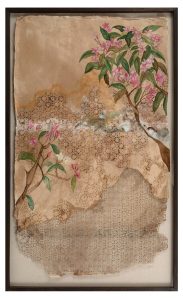
Riddhi Shah, Landscape-Champa outside my Window, 60 x 35 inches, Gouache, Watercolor and Walnut Stain on Sanganeri Wasli Paper & Paper Cut Jali, 2025
Memory is central to this inquiry, but Shah does not approach it as an archive from which the past can be retrieved intact. In her work, recollection is selective and materially unstable. Plants, landscapes and architectural fragments appear through veils of pigment, incomplete outlines, stains and perforations. Recognition is repeatedly interrupted. Images return as memories do: altered by duration, separated from their original contexts and reorganised in relation to the present. The surface does not illustrate remembrance; it enacts its operations of retention, omission and reconstruction.
In the recent landscapes, this structure of recollection meets sustained botanical observation. Champa outside a window, Nilgiri foliage and the intricate flower popularly called Krishna Kamal are not presented as specimens detached from their surroundings. They are familiar presences encountered over time and translated through changes of scale, light and attention. Their names also disclose complex histories of movement. Champa or frangipani and the passionflower are naturalised presences whose cultural associations in India now exceed their geographical origins, while Nilgiri may name both a tree and a landscape shaped by introduced eucalyptus cultivation. Shah’s plants therefore belong simultaneously to domestic memory, cultural narration and histories of circulation. Botanical identity, like personal memory, is neither entirely fixed nor territorially pure.
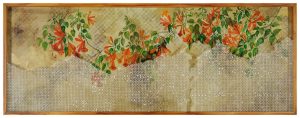
Riddhi Shah, Blooming Veil, 23.5 x 64 inches, Gouache, gold pigment and walnut stain on Sanganeri paper & acid free paper cut jali, 2026
The works resist a simple opposition between organic freedom and geometric order. A flower’s radial symmetry, the disposition of leaves along a stem and the recursive movement of branching all demonstrate that pattern is intrinsic to growth. Yet biological repetition never produces exact copies. Each leaf or bloom follows a shared structure while registering particular conditions of light, nourishment, damage and time. Nature generates coherence through repetition and difference together.
Shah brings this generative order into relation with the patterned screens of Indo-Islamic and, particularly, Mughal architecture. Such screens regulate light, air, vision and spatial passage through the repetition of geometric or vegetal units. Their significance lies not only in ornament but in mediation: they separate without sealing and render a building responsive to the changing day. In Shah’s work, this architectural inheritance is neither quoted as a decorative motif nor treated as a static emblem of the past. It becomes a method for thinking about how vision is framed and how boundaries may remain open.
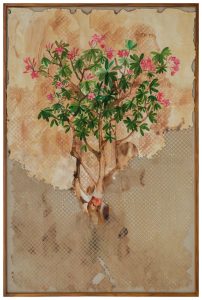
Riddhi Shah, The Garden Remembers, 72 x 48 inches, Gouache, gold pigment and walnut stain on acid free paper & paper cut jali, 2026
Her engagement with Mughal visual culture also extends to the arts of the book. In imperial albums and manuscripts, borders were active pictorial zones in which flowers, animals, calligraphy and ornament inflected the image they surrounded. Under Jahangir, close observation of the natural world acquired particular prominence; under Shah Jahan, flowering plants circulated across architecture, textiles, objects and manuscript illumination. Shah reworks this relationship between centre and margin. Pattern no longer remains obediently at an image’s edge. It overlays the landscape, interrupts it and sometimes appears to propagate across it. Frame and subject become mutually constitutive.
This argument is made through process. Shah works on Sanganeri wasli, a laminated paper support associated with Indian traditions of painting, using gouache, watercolour, gold pigment and walnut stain. The materials perform distinct and sometimes competing functions. Gouache permits opacity and definition; watercolour introduces translucency; walnut stain spreads through the paper in blooms and irregular tonal fields. It carries associations of ageing and weathering, but its significance is not merely atmospheric. Because its movement cannot be wholly predetermined, the stain gives contingency a material role.
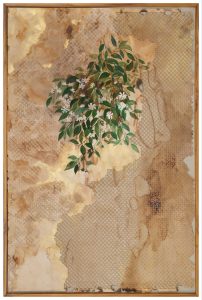
Riddhi Shah, Between Bloom and Falling-Parijat, 72 x 48 inches, Gouache, gold pigment and walnut stain on acid free paper & paper cut jali, 2026
Cutting introduces a different temporal and conceptual register. The incisions are repetitive, precise and slow. Pigment accumulates upon the surface while cutting removes parts of it; elaboration is achieved through subtraction. Absence consequently becomes material rather than symbolic. Wall, ambient illumination and cast shadow enter the image through the openings, making its appearance dependent upon its surroundings. Shah’s process holds calculation and accident in productive tension: the cut establishes a system, while stain, shadow and viewpoint ensure that the system never produces a final or identical image.
The new wall installation brings these concerns into architectural space. Conceived across a surface approximately twelve feet wide and eight feet high, it translates the vocabulary of the paper works into laser-cut mild steel. Enlarged leaves, stems and flowering clusters are distributed among fragments of repeating lattice without a continuous rectangular boundary. Dense passages gather and disperse; units seem to propagate, separate and re-form across the wall. The composition is ordered, but its edges remain unresolved.
The change of medium is consequential. Paper’s intimacy and vulnerability give way to the weight and durability of three-millimetre steel, yet the installation resists becoming a massive or closed object. Its components are mounted away from the wall so that light produces another composition in shadow. As illumination changes and viewers move before it, the work is continually redrawn. Their bodies briefly interrupt its projections and enter its perceptual field. The installation thus makes explicit what the works on paper propose at a smaller scale: an image is not autonomous, but produced through relations among material, site, light and the moving observer.
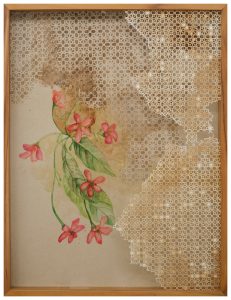
Riddhi Shah, Studies of the Familiar, 17.5 x 13.5 inches, Gouache, gold pigment and walnut stain on acid free paper & paper cut jali, 2026
At this enlarged scale, the distinction between the botanical and the architectural becomes increasingly unstable. The lattice fragments spread with the irregular momentum of growth, while the plants reveal their own systems of symmetry, recurrence and branching. Shah does not simply juxtapose geometry and nature. She shows geometry operating within nature and architectural pattern behaving like a living formation—expanding through the repetition of units, but remaining responsive to circumstance.
This convergence gives the work its philosophical resonance. The recurring structures of flowers, leaves and branches suggest a world shaped by underlying designs. Human beings readily recognise beauty in such regularity, yet remain ambivalent about the patterns governing their own lives. We inherit biological rhythms, familial histories, social conventions and habits, while also claiming the freedom to depart from them. Shah’s works do not resolve this tension by opposing order to autonomy. Instead, they propose that difference emerges from within repetition. As in a plant, a city or a remembered image, form persists by changing.
What the Light Remembers therefore describes more than the effect of illumination upon a perforated surface. Light is the condition that reveals relation: between image and support, interior and exterior, inherited form and present perception. Shah’s practice repeatedly establishes boundaries and then renders them permeable. What crosses those boundaries is never preserved unchanged. It is displaced, refracted and reconstituted. Memory, like light, becomes visible through the structures it encounters—and through the ways it exceeds them….
– Priya Pall

