Floral Mosaics
By Nvyā Editorial | Published on Jun 4, 2026 | in Art Curators, Art gallery
Floral Landscapes: From Observation to Immersion
Across the history of art, flowers have served as a charged and mutable motif through which artists articulate their relationship to nature. Oscillating between scientific observation, symbolic meaning, emotional expression, and ecological awareness, floral imagery has persistently mediated between the specificity of botanical form and broader cultural frameworks of perception. Flowers have rarely functioned as mere ornament. Instead, they have acted as sites of projection—condensing knowledge systems, aesthetic ideologies, and environmental attitudes into visual form.
Within this lineage, the floral landscape occupies a particularly complex position. Unlike the flower still life—traditionally bounded, interior, and emblematic—the floral landscape situates blossoms within lived and often immersive environments: gardens, fields, forest interiors, and cultivated terrains shaped by both human intervention and organic growth. Here, flowers are relational rather than isolated, embedded within systems of light, atmosphere, fauna, and seasonal time. It is within this expanded field that the floral motif shifts from object to condition, from specimen to environment. The present curatorial framework traces this trajectory across Western and Eastern art histories before situating the contemporary practice of Sandeep Jigdung within a transhistorical understanding of ecological floral landscape painting.
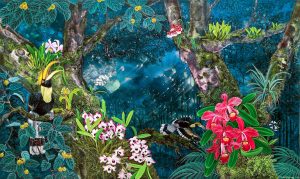
Sandeep Jigdung, SAJI-0093, Untitled, 42 x 72 inches, Acrylic on canvas, 2025
Art-Historical Context: From Scrutiny to Immersion
In Western art, the early modern period marks a critical moment in the articulation of floral imagery. During the Dutch Golden Age, advances in botany, scientific classification, and global trade converged with painterly virtuosity to produce highly detailed flower still lifes. Artists such as Jan Davidsz de Heem and Maria van Oosterwijck rendered lavish bouquets composed of flowers that could not bloom simultaneously, collapsing temporal and geographical boundaries into a single, meticulously ordered image. Though these works are not landscapes in a conventional sense, they nonetheless articulate nature as a system that can be observed, catalogued, and mastered. Flowers appear centrally arranged against dark, controlled grounds, bearing symbolic weight while remaining subject to human compositional authority.
A decisive shift emerged in the nineteenth century as Romanticism and Impressionism dismantle this logic of containment. Vincent van Gogh transformed flowers into emotive, gestural forms inseparable from colour, movement, and psychological intensity. His sunflowers, irises, and flowering fields dissolve the boundary between still life and landscape, embedding floral motifs within environments charged by inner life. This trajectory reaches its most immersive articulation in the work of Claude Monet, whose gardens at Giverny collapse distinctions between motif, site, and subject. In the water lily paintings, botanical specificity gives way to atmospheric sensation: horizon lines disappear, spatial depth flattens, and the viewer is enveloped within a continuous pictorial field.
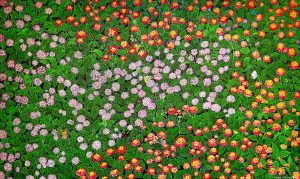
Sandeep Jigdung, SAJI-0094, Untitled, 42 x 72 inches, Acrylic on canvas, 2025
Parallel developments unfolded in Eastern artistic traditions, particularly in Japanese ukiyo-e. Utagawa Hiroshige integrated flowers into expansive landscapes structured by seasonality, weather, and cultural ritual. In these works, flowers rarely function as isolated subjects. Instead, they operate as temporal markers—signifying impermanence, renewal, and cyclical time—within a cosmology that emphasises continuity between humans and the natural world. This integrated vision would later exert a profound influence on Western modernism, though its philosophical grounding in balance and ephemerality remains distinct.
Modernism further reconfigured floral imagery as artists explored abstraction, surface, and interior experience. Georgia O’Keeffe magnified flowers to monumental scale, transforming petals into immersive terrains that hover between still life and landscape. Conversely, artists such as Edouard Vuillard, Mary Cassatt, and Henri Fantin-Latour absorbed floral motifs into intimate interiors, privileging pattern, domesticity, and surface over environmental immersion. In contemporary practice, painters such as Joanne Short revisit floral environments through expressive colour and gestural density, reaffirming the relevance of the floral landscape as a site of sensorial engagement.
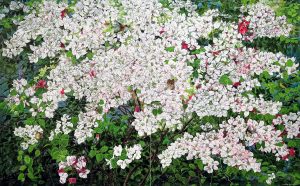
Sandeep Jigdung, SAJI-0098, Bougainvillea, 60 x 96 inches (diptych), Acrylic on canvas, 2025
It is within this expanded and transhistorical field—spanning observation, immersion, abstraction, and ecology—that Sandeep Jigdung’s practice emerges with particular clarity.
Sandeep Jigdung: Ecological Floral Landscape Painting
Jigdung’s paintings—lush, intricately resolved views of flowering shrubs, orchids, vines, and forest undergrowth—reposition floral imagery firmly within the domain of lived ecology. Unlike the contained still-life paintings of de Heem or Fantin-Latour, his compositions refuse isolation and hierarchy. Flowers do not sit apart from their surroundings; they emerge from dense, interdependent systems of foliage, light, insects, and avian life. Birds and butterflies recur not as symbolic embellishments but as ecological agents, emphasising processes of pollination, migration, and environmental continuity.
Rooted in the biodiverse landscapes of north-east India, Jigdung’s work articulates a vision of nature shaped by coexistence rather than domination. This region—marked by tropical humidity, layered vegetation, and long-standing forest cosmologies—functions not merely as a source of imagery but as a conceptual framework. His paintings suggest environments encountered from within rather than surveyed from a distance. There is no elevated vantage point, no panoramic overview; instead, the viewer is drawn into dense, enveloping spaces where vegetation presses close and depth unfolds gradually.
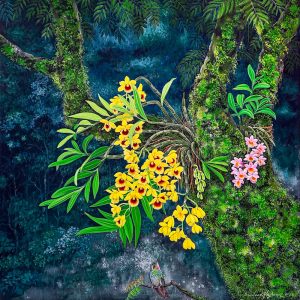
Sandeep Jigdung, SAJI-0090, Untitled, 36 x 36 inches, Acrylic on canvas, 2025
Situating Jigdung within a broader art-historical frame reveals both continuity and divergence. Like Monet, he embeds flora within immersive environments; like Hiroshige, he integrates plants into broader natural rhythms governed by time and seasonality. Yet unlike O’Keeffe, he resists isolation and magnification, favouring relational density over singular form. His work does not abstract the flower from its environment but insists on its embeddedness within ecological networks.
In an era marked by environmental precarity and accelerated modes of seeing, Jigdung’s paintings advocate for slowness, attention, and sustained looking. They remind us that floral landscapes are not merely aesthetic genres but critical sites where art negotiates humanity’s relationship with the natural world. Through botanical specificity, ornamental richness, and ecological awareness, Jigdung reclaims the floral landscape as a space of continuity—where history, environment, and perception converge.
– Priya Pall
Curatorial Advisor