Bodies of Sky, Bodies of Earth
By Nvyā Editorial | Published on May 4, 2026 | in Art Curators, Art gallery
Bodies of Sky, Bodies of Earth is a solo exhibition by Seema Kohli that emerges from the conceptual and material rigor of her practice. The exhibition’s spatial and scenographic structure develops through close engagement with Kohli’s sustained inquiry into matter as simultaneously physical, metaphysical, and philosophical. Rather than functioning as a narrative imposed upon the work, the exhibition expands the internal logic of her practice into space, allowing material processes to shape both form and experience.
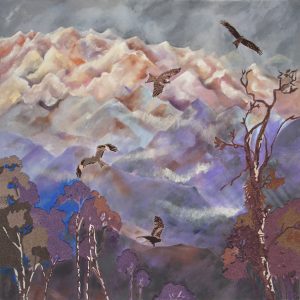
Seema Kohli, The flutter of her wings and the unbending mountains, 60 x 60 inches, Mix media on recycled plastic yarn, 2025
Kohli’s work is grounded in an understanding of matter as active and generative. Clay, wood, paper, metal, pigment, and light are treated not as inert substances but as sites of transformation that register time, touch, and resistance. This position aligns her practice with materialist and post-phenomenological thinking, in which matter is understood as relational and dynamic, embodied and reciprocal rather than passive. The works retain visible traces of their making, treating process as knowledge and material as a site of memory, imagination, and transformation.
The exhibition unfolds as a conceptual passage that reflects Kohli’s long-standing engagement with the body as a locus of experience. Its arc moves from the idea of origin or womb, through the conditions of earth and embodied life, toward sky, release, and shedding, with moksha functioning as an orienting horizon. This progression is articulated materially rather than symbolically, echoing philosophical traditions in which transcendence is understood not as a departure from matter, but as transformation through it.
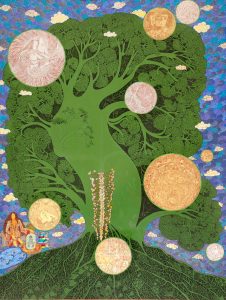
Seema Kohli, SK-0291, Tree of Life, 96 x 72 inches, Acrylic colours and ink on canvas with 24kt gold and silver leaf, 2025
At the entrance, a large-scale gilded work establishes the condition of origin. Gold and silver leaf are treated materially, functioning as fragile skins responsive to pressure, heat, and handling. Variations in surface and sheen make visible the labor of application. While recalling devotional material traditions from South Asia, the work also resonates with modernist and post-minimal investigations of surface and material presence, from Yves Klein’s use of gold to the tactile immediacy of Arte Povera.
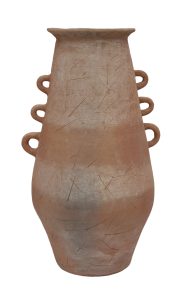
Seema Kohli, 21 x 33 x 6 inches, Terracotta Objects, 2025
Terracotta works form the exhibition’s grounding core. Shaped through compression and fire, they retain the imprint of the hand and resist refinement. Appearing as fragments, markers, or vessels, they evoke archaeological and vernacular forms without settling into historical quotation. In this regard, Kohli’s sculptural language aligns with postwar ceramic and sculptural practices that foreground process and tactility, including the work of artists such as Lucie Rie, as well as contemporary practices that collapse distinctions between object, body, and architecture.
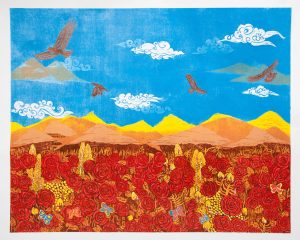
Seema Kohli, SK-0273, Between heaven & Earth – Rose Garden, 48 x 60 inches, Woodcut print on paper, 2025
Works on paper introduce a contrasting register of permeability and breath. Pigment enters the fibers through absorption and staining, producing surfaces sensitive to timing and restraint. These works register vulnerability rather than mass, situating Kohli’s approach within phenomenological traditions of drawing and painting. They can be read through Maurice Merleau-Ponty’s account of perception as embodied and reciprocal, where the visible is inseparable from the sensing body. Their emphasis on atmosphere and temporal change also recalls Gaston Bachelard’s writing on elemental matter and the poetics of air, as well as Indian philosophical traditions that understand breath as a bridge between material and subtle experience, from prāṇa in yogic thought to the Upanishadic sense of the life-force animating form. Here, the sheet becomes a permeable field in which material and sensation co-produce the image, privileging process and embodiment over representation.
At the center of the exhibition, a monumental woodcut functions as a hinge between earth and sky. The force required to carve the block remains visible in the printed surface, translating resistance into trace. The woodcut’s transformation of pressure into image aligns with phenomenological emphases on matter as process and becoming rather than fixed form, while its disciplined repetition and imprint evoke the Indian concept of saṃskāra, the residual impression left by action. Beyond this point, carved wooden forms reinforced with metal fittings introduce movement and lift, negotiating between organic growth and structural constraint. Their suspended tensions recall sculptural lineages of balance and load, while conceptually they echo Abhinavagupta’s account of vibration and emergence, where form is understood as a dynamic relation rather than a stable object
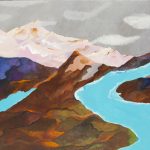
Seema Kohli, SK-0288, Rewritten Skies, 48 x 120 inches, Acrylic colours on canvas with silver leaf, 2026
Throughout Bodies of Sky, Bodies of Earth, matter operates across registers. It is physical in its weight and resistance, metaphysical in its capacity to hold memory and transformation, and philosophical in its insistence on relational becoming. The exhibition articulates moksha not as an escape from materiality, but as a process of shedding achieved through sustained attention to matter itself.
Satyajit Dave
Mumbai, 2026