Silent echoes of a flight beyond and whispers of the earth beneath…
By Nvyā Editorial | Published on Nov 25, 2025 | in Art Curators, Art gallery
Lal Bahadur Singh, born in 1985 in Uttar Pradesh, has quickly established himself as a prominent voice in contemporary art, capturing a universal narrative of transformation and change. His artistic journey began in the traditional Guru-Shishya Parampara in Gazipur, where he first connected with the cultural and artistic practices that rooted him in rural life. This early immersion in the stories and landscapes of the land continues to inform his work, which now transcends geographical boundaries. A graduate of the College of Art, New Delhi, where he earned a Master’s degree in Fine Art, Lal Bahadur’s work exists at the intersection of tradition and modernity. His paintings often juxtapose the enduring symbols of rural life with the rapid, sometimes relentless, urbanization of the contemporary world. This contrast serves as a reflection not only on the shifting landscapes of India but also on the global tensions between nature, industry, and the complex dynamics of progress. Through his evocative use of colour and form, Lal Bahadur explores themes of displacement, loss, and resilience, offering a poignant commentary on the challenges of modernization. Through his art, he invites viewers to reflect on the broader human experience—capturing the beauty and tension that arise as societies navigate the delicate balance between change and continuity.
Lal Bahadur Singh, City Park, 60 x 96 (diptych) inches, Acrylic on canvas, 2024-25
In this particular exhibition, Lal Bahadur Singh Artist presents a world where the tension between nature and urbanization pulses through every canvas. His works, devoid of human figures, are teeming with life in the form of vividly painted birds—parrots, sparrows, woodpeckers, and seagulls. These creatures, rendered in jewel-like hues, symbolize nature’s resilience while sharply contrasting the encroachment of industrialization. The delicate birds evoke the fragility and fleeting beauty of nature, set against the stark, mechanical world of construction and urban growth.
Lal Bahadur Singh, Unknown Journey, 60 x 48 inches, Oil on canvas, 2024
One of the artist’s most striking motifs is the use of gold-burnished bricks, often stacked as they are on construction sites, symbolizing the building blocks of development. These bricks, in their sterile uniformity, create a stark dichotomy with the radiant birds. In one painting, a hybrid creature—peacock—perches atop a stack of bricks, its iridescent feathers framed by lush greenery. The contrast highlights nature’s distorted beauty in an increasingly artificial world. A sparrow soars above, liberated yet tethered to the crumbling, constructed world below. The red background heightens the urgency, as if the landscape itself is burning with the tension between nature and urbanization.
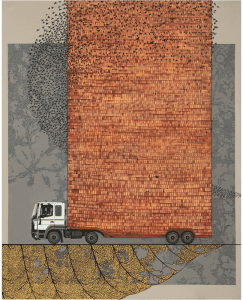
In another striking image, an eight-wheeler truck transports a towering stack of bricks, its precarious “skyscraper” on its way to an unknown destination. Above, birds swirl in disarray, their flight disturbed by the weight of human-made structures. Beneath the truck, withered trees are crushed under the weight of progress, symbolizing nature’s subjugation to industrial forces. The artist paints the displacement of life as trees, once shelters for birds, are reduced to mere obstacles in the path of development. Singh’s canvases also depict the encroachment of urbanization into the natural world, where gaps in brick structures are filled with birds’ nests. A bird guards its eggs in one such nest, a quiet acknowledgment that, with the vanishing of trees, the birds must now find refuge in the very materials that symbolize development. In a larger diptych, the stacked bricks become a home for various birds, who nest in the cracks of the bricks, or rest in precarious perches. The once-lush forests have given way to cold, sterile construction, an unsettling symbol of nature’s forced adaptation.
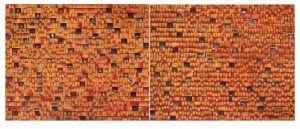
Lal Bahadur Singh, Untitled, 48 x 120 (diptych) inches, Acrylic on canvas, 2024
Further deepening the connection between industrialization and nature, Singh introduces rebars—steel reinforcements used in concrete—into his landscapes. These grids form the framework in which birds now reside, some in flight, others in nests, each meticulously detailed. The rebars, though subtle, remind the viewer that the birds are now forced to build their homes within the man-made lattice of steel, replacing the once-available trees with industrial structures.
Despite this harsh reality, the vibrant birds remain a symbol of hope, representing nature’s enduring resilience, even in the face of overwhelming artificiality. Through his masterful use of colour and form, Singh conveys the ongoing tension between nature’s beauty and the relentless march of urbanization. The birds, with their delicate brilliance, signify life’s persistence—adaptable, resilient, and enduring—while the bricks, steel, and towering structures signify the weight of human development.
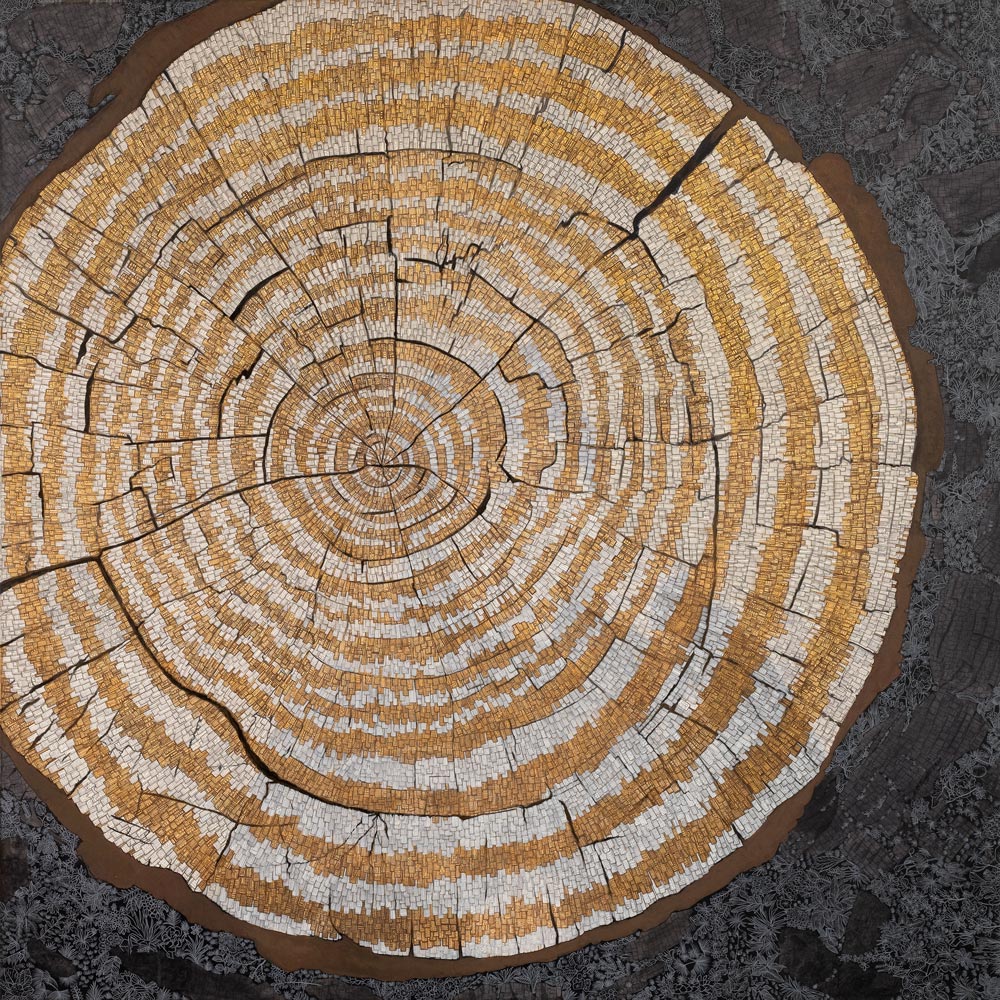
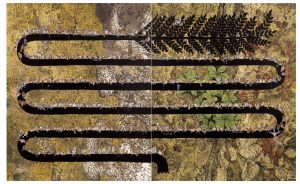
Singh’s paintings of trees deepen this narrative of loss and resilience. In one work, a fossilized tree trunk, its rings painted in gold, subtly incorporates the silhouettes of buildings, symbolizing the irreversible mark of industrialization on the natural world. The juxtaposition of organic and constructed elements reflects the growing encroachment of human development on nature. A felled tree trunk transforms into a city of skyscrapers, with displaced birds swirling around, lost in a new urban landscape. The red backdrop imbues the scene with urgency, symbolizing the disruption of ecological harmony. In another piece, a blackened serpentine tree winds across a diptych, its barren form inhabited by birds perched on every inch of its trunk. The left side of the canvas, bathed in dull grey with rising silhouettes of buildings, contrasts with the green foliage of the right side, suggesting the possibility of renewal despite the tree’s decay. This image captures both the persistence of life and the destructive pull of urban sprawl, with the birds offering a glimmer of hope amidst the desolation.
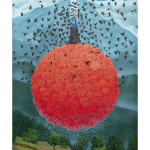
Lal Bahadur Singh, Chasing Concrete’s Shine, 72 x 48 inches, Oil on canvas, 2024
Singh’s use of beauty to amplify devastation speaks to the inevitability of destruction brought by industrialization. In one painting, ears of golden wheat, symbolizing sustenance and growth, are inhabited by sparrows and parrots, reflecting the intersection of nature’s bounty and the industrial world. The birds, perched on the wheat, evoke a fragile balance, suggesting that life continues to adapt, even when forced into unnatural environments. Lal Bahadur also introduces symbolic motifs like a giant red apple, suspended unattainably above the landscape, symbolizing desire, knowledge, and the allure of a world promising prosperity and indulgence. From this apple, an apple tree emerges, its growth severed from vitality, transformed into a mechanical, industrialized version of itself. The maze-like path leading from the tree symbolizes the tangled web of aspirations that, when pursued without balance, lead to stagnation and disillusionment.
But the artist is not a cynic. Each work also pulses with life, symbolizing vitality, natural abundance, and the untapped potential of a world in harmony with its environment. The works also speak to the possibility of a more balanced, sustainable existence—one where growth is rooted in authenticity, where nature’s rhythms are not disrupted, but nurtured. It is a vision of hope, of what might be, were humanity to re-align itself with the natural world and seek true progress. He masterfully weaves together beauty and despair, life and decay. The trees, whether fossilized, fallen, or blackened, represent the erosion of the natural world by the relentless forces of industrialization, while the birds—resilient, vibrant, and ever-present—serve as symbols of nature’s enduring spirit. Through the delicate rendering of both life and loss, the artist conveys a powerful, poignant message: though the world around us may change, the beauty and resilience of nature will forever remain, even if only in the smallest, most unexpected forms.
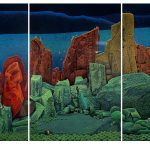
Lal Bahadur Singh, Organic City, 72 x 240 inches, Acrylic on canvas, 2025
In its entirety, the exhibition is a poignant commentary on the paradox of modern life: the insatiable hunger for progress and abundance, embodied by the giant apple or ears of wheat, contrasts sharply with the environmental decay, social inequality, and loss of individuality that progress often entails. Singh’s masterful blend of vivid symbolism invites us to reflect on the tension between technological advancement and its ecological and human costs. He urges us to question whether the paths we take toward prosperity are indeed the ones that nourish us, or whether they lead us into a landscape where the promise of a brighter future is choked by the very forces that should propel us forward. He weaves together a visual meditation on the complexities of modern existence: the dream of abundance, the reality of environmental collapse, and the fragile balance between the two. His work speaks not only to the beauty of nature and the allure of progress but also to the dangers of losing touch with both.
The largest work in the exhibition, Organic City, consists of five expansive canvases, in which the artist envisions a world where the boundaries between nature and human creation dissolve. The city, with its buildings wrapped in greenery, blurs the line between the man-made and the organic. The exposed steel rebar in the structures reminds us of the industrial past, while the thriving foliage represents nature’s resilience. Wild and domestic animals roam freely, suggesting that all life forms—human, animal, and plant—are interconnected. The shadow of a dinosaur lingers, evoking the ancient past, while modern symbols of transport, like the steam engine and helicopter, coexist in a single frame. These fusion challenges our understanding of time, suggesting that history, present, and future are more fluid than we often think.
Amidst these profound reflections, there is a sense of playful exploration. Whimsical details—such as a bookshelf, kites, or a lonely tennis court—may be found in the chaos of modern existence. The presence of humans is subtle. They remain elusive, but engaged with a larger, interconnected world, one that signals a future where the natural and human realms are woven together in a harmonious whole. The artist seeks to capture the essence of this place, rendering it in a manner that feels eternal, its contours and textures meticulously rendered, inviting contemplation on the passage of time.
As the exhibition title Silent Echo of the Flight Beyond, and Whispers of the Earth Beneath suggests, we arrive at the profound juxtaposition embodied in this monumental work, with one where a multitude of birds carry their giant nest above the clouds, ascending away from the weight of an over-industrialized world. This ethereal flight represents a longing for liberation, a departure from the confines of human-made structures and the ceaseless hum of progress. It is an almost serene escape into the vast expanse of possibility, where nature and spirit transcend the noise below, whispering their own silent, yet resounding, message of hope and renewal.